Kirin learns 3D quadruped motion directly from internet video, and turns a single image plus a text prompt into a fully rigged, animated mesh.
Understanding animal motion is fundamental to modeling animal behavior and biomechanics, yet progress in this area lags far behind human motion research due to the scarcity of high-quality motion data. While human motion can be captured in controlled environments, it is impractical for most animal species, resulting in small, domain-limited datasets that restrict downstream applications such as animation.
To address this challenge, we introduce Kirin, a framework that reconstructs motion from video, learns motion priors at scale, and generates realistic motion that can be directly applied to animated assets. Using large collections of in-the-wild animal videos, we reconstruct 3D motion sequences and pair them with captions to create AiM3D, the first large-scale dataset offering aligned video-text-motion tuples for quadruped animals. Building on this dataset, we develop a visual-guided motion generation model that conditions on both text and image to guide the generation of realistic motion across diverse animal species. Finally, by leveraging an off-the-shelf image-to-3D model, we automatically rig and animate 3D meshes using generated motion, producing ready-to-render animated animals. Together, our dataset and framework establish a new foundation for large-scale, text and image conditioned animal motion generation and animation.
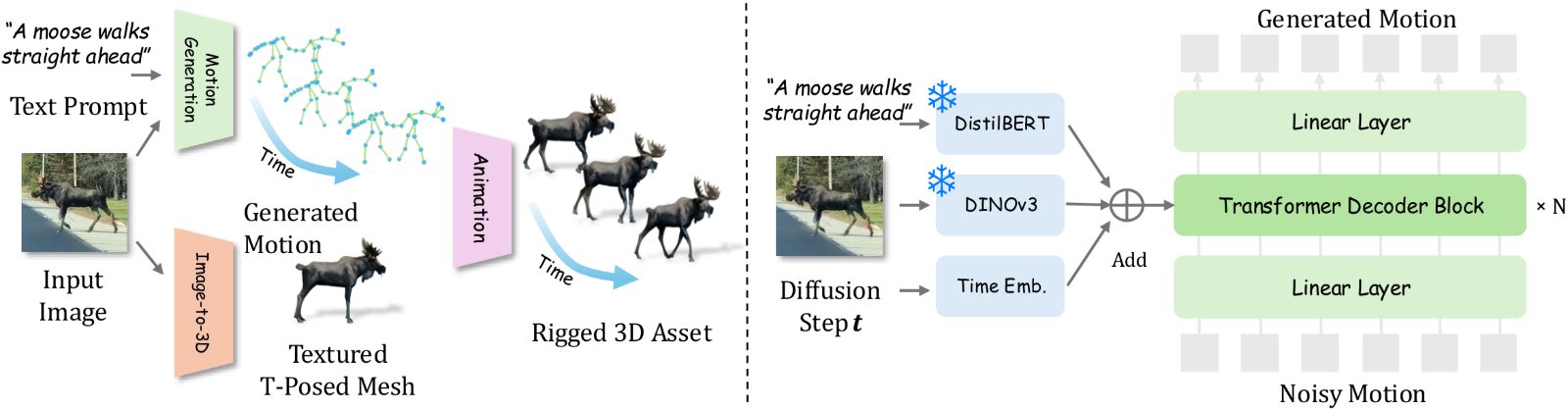
A two-stage pipeline. A diffusion-based motion model conditioned on text and image generates the 3D motion; an automatic rigging module applies it to a T-posed mesh produced from the same image.
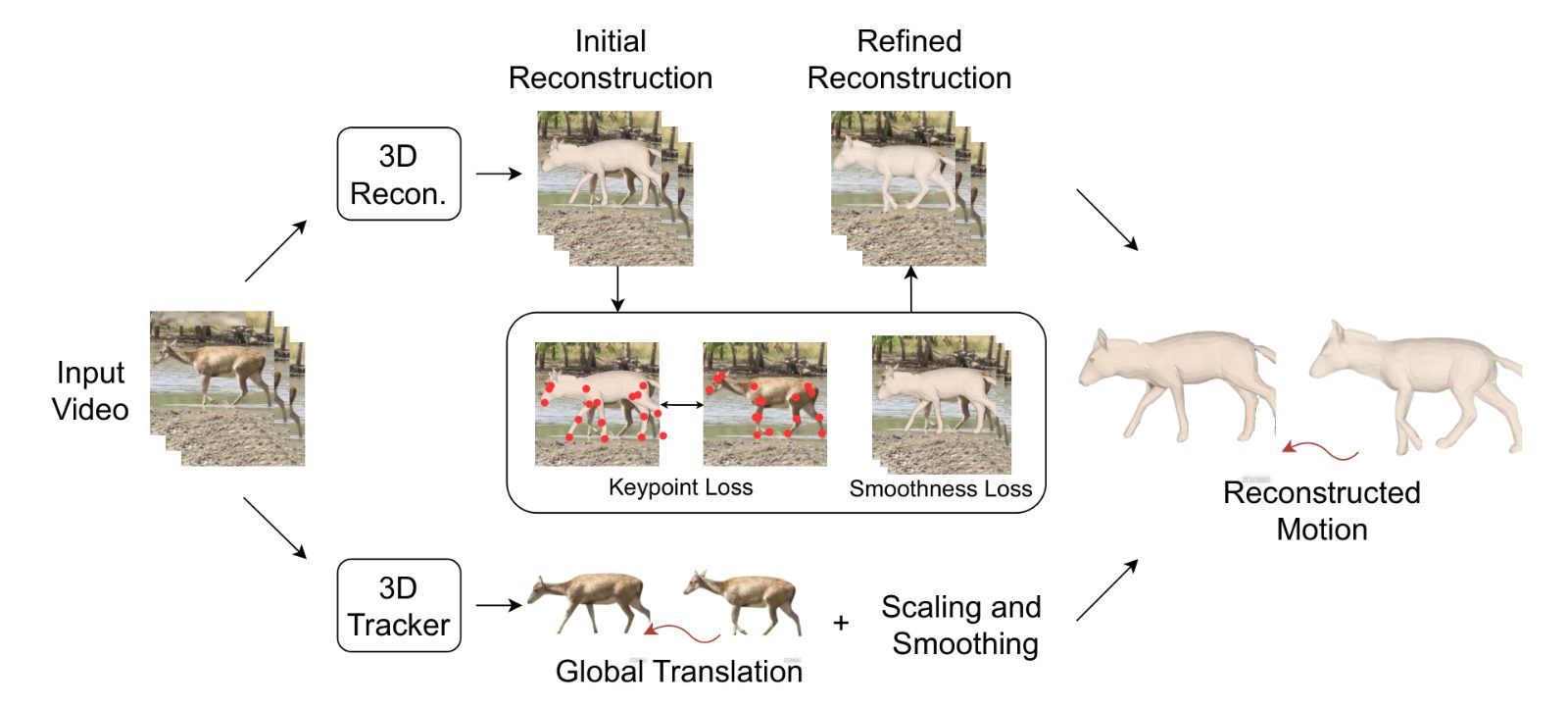
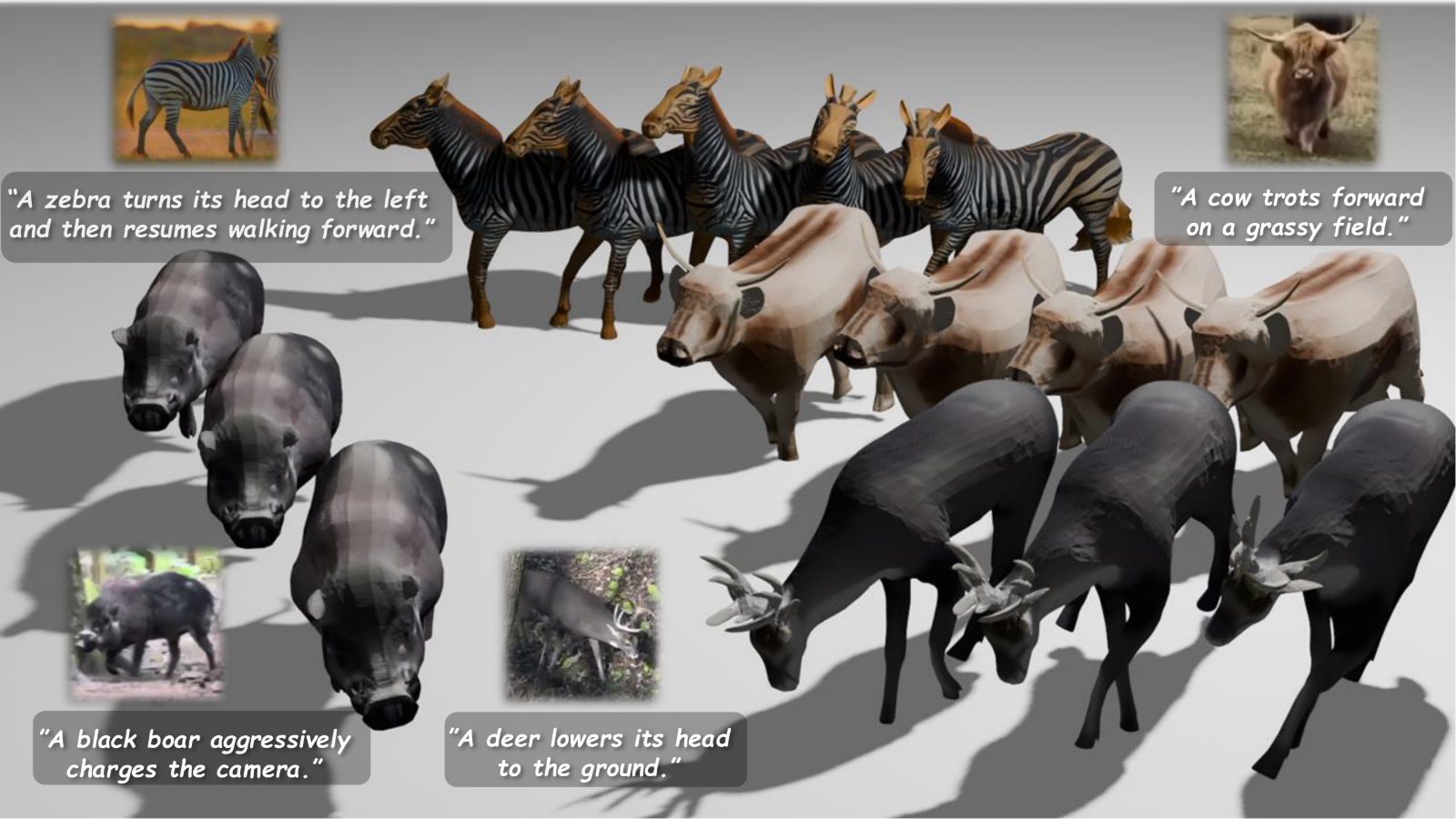
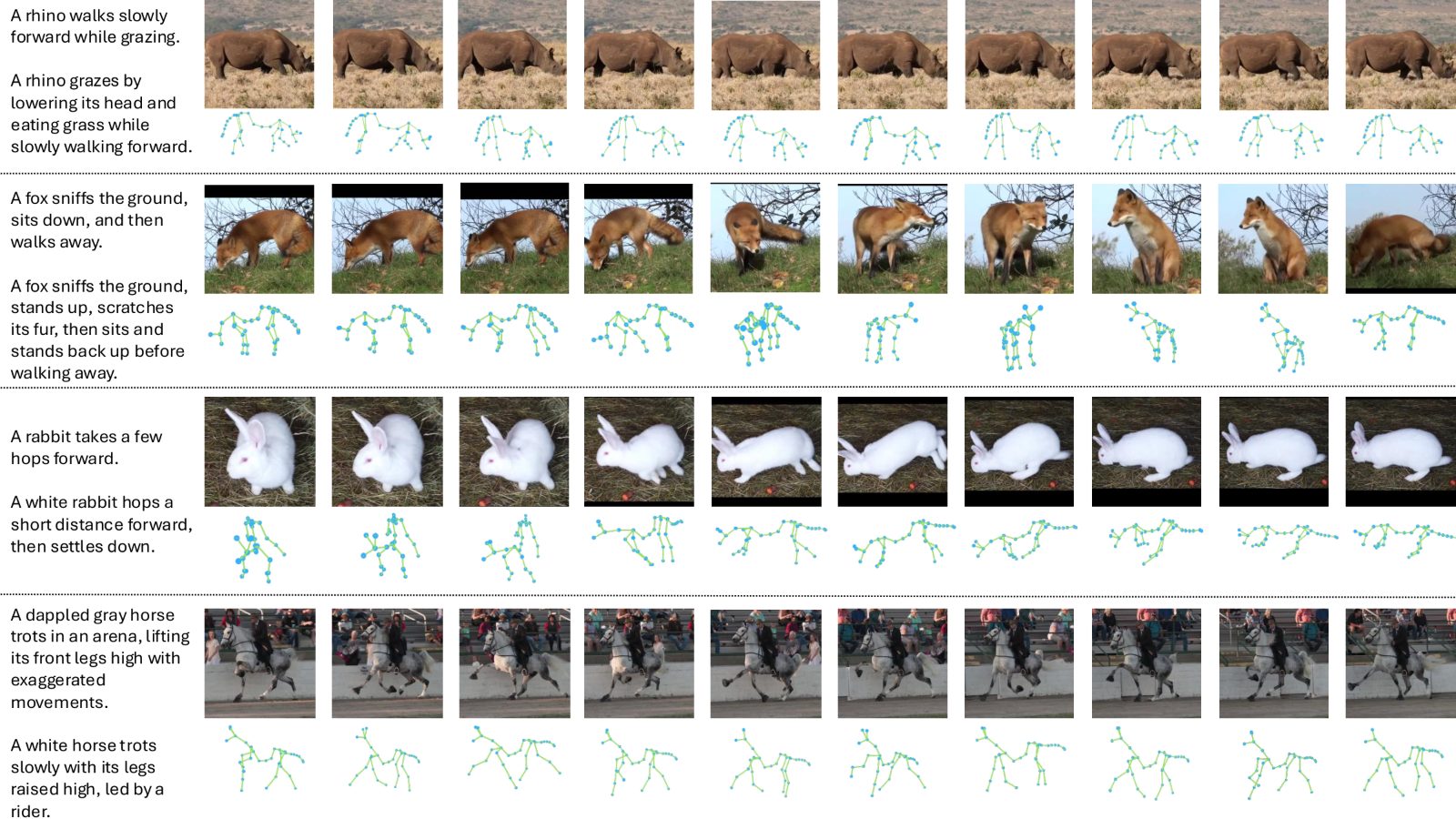
A large-scale animal motion dataset with aligned video, text, and 3D motion. Reconstructions cover diverse species, behaviours, and environments far beyond what controlled capture can offer.
new_joints.npy and new_joint_vecs.npy
reconstructions; Mean.npy, Std.npy,
train.txt and test.txt provide the
normalisation statistics and the official split.
wget -c https://download.cs.stanford.edu/viscam/AiM/AiM_full/horse.zip
Or fetch everything, metadata included:
wget -c -r -np -nH --cut-dirs=3 -R "index.html*" https://download.cs.stanford.edu/viscam/AiM/AiM_full/
Side-by-side qualitative comparisons of generated mesh and skeletal animation against the strongest published baseline. Drag to inspect; click pause to hold a frame.
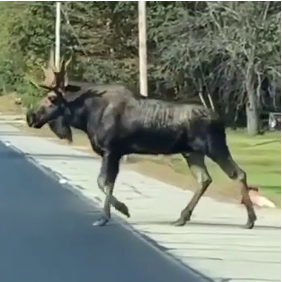
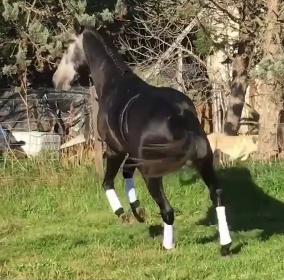
 Left-click drag to rotate
 Right-click drag, or WASD to move
 Scroll to zoom
 to pause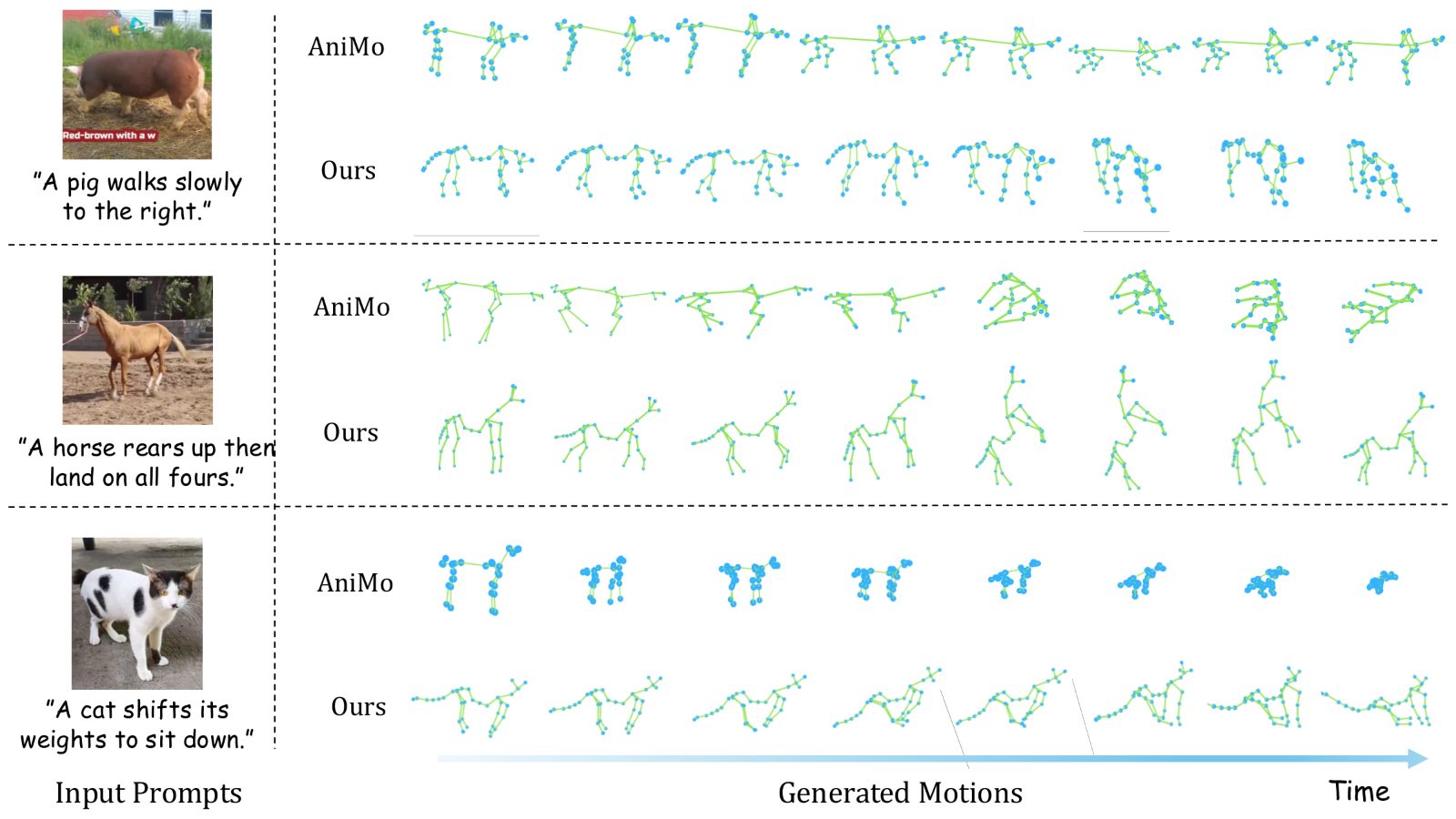
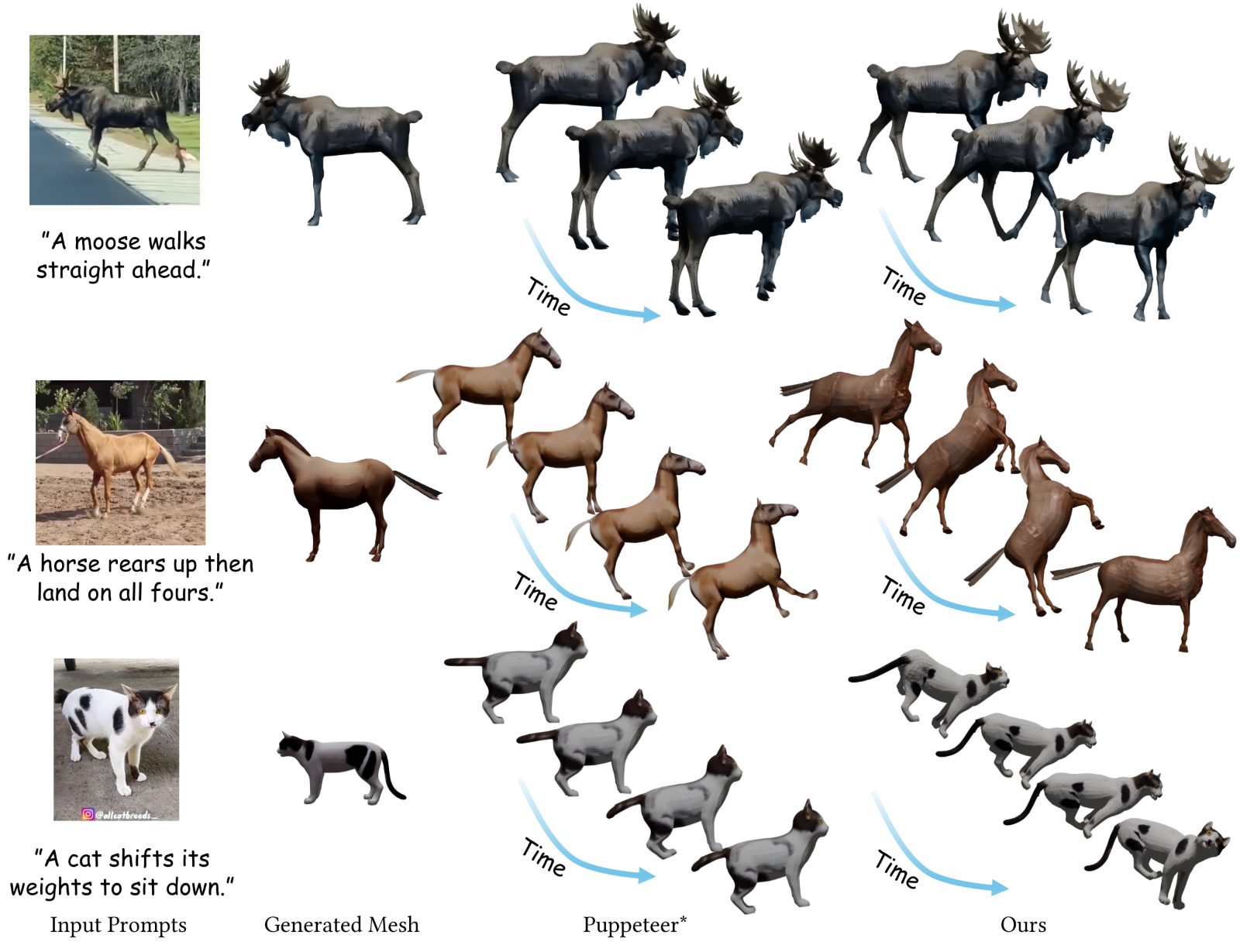
Across motion-generation metrics and 4D animation benchmarks, Kirin outperforms or matches prior methods. Best results in color; second-best underlined.
| Method | R-Prec. Top-1 ↑ | R-Prec. Top-3 ↑ | FID ↓ | MM-Dist ↓ | Diversity ↑ |
|---|---|---|---|---|---|
| Real motion | 0.512±.004 | 0.823±.003 | 0.002±.001 | 2.974±.008 | 9.503±.065 |
| MDM | 0.298±.005 | 0.612±.004 | 1.842±.040 | 4.918±.011 | 8.612±.078 |
| MotionDiffuse | 0.321±.004 | 0.658±.005 | 1.514±.034 | 4.671±.012 | 8.804±.080 |
| T2M-GPT | 0.354 | 0.701 | 1.288±.030 | 4.402 | 9.014 |
| MoMask | 0.346±.005 | 0.689±.004 | 1.196 | 4.477±.010 | 8.961±.071 |
| Kirin (text-only) | 0.392±.004 | 0.748±.003 | 0.974±.026 | 4.142±.009 | 9.182±.069 |
Even without image conditioning, Kirin's architecture trained on AiM3D outperforms the strongest text-to-motion baselines across all five standard metrics. Numbers reported on the AiM3D test split with 95% confidence intervals.
| Method | R-Prec. Top-1 ↑ | R-Prec. Top-3 ↑ | FID ↓ | MM-Dist ↓ | Image-CLIP ↑ |
|---|---|---|---|---|---|
| Real motion | 0.512±.004 | 0.823±.003 | 0.002±.001 | 2.974±.008 | 0.298±.003 |
| MDM + img | 0.331±.005 | 0.671±.004 | 1.487±.038 | 4.604±.011 | 0.221±.003 |
| MoMask + img | 0.378 | 0.722 | 1.041 | 4.291 | 0.247 |
| Kirin (full) | 0.421±.004 | 0.776±.003 | 0.812±.022 | 3.978±.010 | 0.281±.003 |
Conditioning on the input image alongside the text prompt — through a frozen DINOv3 encoder fused with text and time embeddings — yields the largest gains on FID and Image-CLIP, indicating that motion better matches the appearance and identity of the depicted animal.
| Method | CLIP-T ↑ | CLIP-I ↑ | Temporal Cons. ↑ | User Pref. ↑ |
|---|---|---|---|---|
| Animate124 | 0.218±.004 | 0.704±.005 | 0.812±.006 | 11.4 % |
| 4D-fy | 0.231±.004 | 0.728±.005 | 0.847±.005 | 14.8 % |
| Puppeteer* | 0.262 | 0.781 | 0.881 | 21.7 % |
| Kirin (ours) | 0.291±.003 | 0.812±.004 | 0.924±.004 | 52.1 % |
A user study with 38 participants comparing 24 prompt × image pairs from a held-out evaluation set; participants picked the most realistic animation per prompt. Kirin wins a majority of comparisons. * Reproduced; no public code at submission.
If you find this work useful, please consider citing our paper.
@inproceedings{zhao2026kirin,
  title     = {Kirin: Animal Motion Generation from In-the-Wild Video},
  author    = {Zhao, Brian Nlong and Pan, Zhuoyang and Rehg, James M. and Wu, Jiajun and Wu, Shangzhe},
  booktitle = {Computer Vision -- ECCV 2026},
  series    = {Lecture Notes in Computer Science},
  pages     = {1--19},
  publisher = {Springer},
  year      = {2026},
  doi       = {10.1007/978-3-032-37261-1_1}
}